




What is Gunpla? Gunpla Guide: Grades, Scales, and Gundam Model Kits
If you are stepping into the world of Japanese scale modeling, you have likely encountered terms like Gunpla, Gundam, HG, RG, MG, PG, and SD. For anyone approaching this hobby for the first time, all these acronyms can feel quite overwhelming.
However, understanding what each one means is much simpler than it seems. In this guide, we will explain what Gunpla is, its relationship to Gundam, what the different grades and scales mean, and key differences across major model lines.
What is Gunpla?
Gunpla is the common term for plastic model kits based primarily on the Gundam franchise. The word itself is a portmanteau of Gundam and Plastic Model.
These are scale model kits that arriveunassembled, requiring the builder to construct the model using the various parts supplied in the box. Parts come attached to plastic frames known as runners (or sprues), which must be cut out and assembled according to the instruction manual.
One of the features that has made Gunpla so immensely popular is its construction engineering. Most modern kits feature snap-fit assembly, requiring no glue for basic construction.
This does not mean modelers cannot use additional tools, paints, or hobby products. On the contrary: carefully trimming parts, cleaning nub marks, applying panel lining, placing decals, or custom painting armor plates allows builders to elevate the final finish significantly.
Therefore, a Gunpla kit can be enjoyed as a straightforward snap-fit project or developed into an elaborate modeling craft, depending on the builder's goals.
If you are considering building your first model or expanding your collection, check out our Gunpla section to explore Gundam model kits across every grade and scale, from HG and RG kits to MG, SD, and beyond.
What Is the Relationship Between Gunpla and Gundam?
To understand the origins of Gunpla, we must look at Gundam. Gundam is one of Japan's most iconic sci-fi and mecha franchises, debuting with the anime television series Mobile Suit Gundam in 1979.
The franchise revolves around fictional universes torn by conflicts where piloted humanoid war machines called Mobile Suits take center stage.
The name Gundam can refer to the umbrella franchise as well as specific flagship Mobile Suits featured throughout its various storylines.
Gunpla was born from the idea of translating these Mobile Suits and military vehicles into plastic scale model kits for fans to build and collect.
It is important to distinguish between the two concepts:
- Gundam is the overall franchise and story universe encompassing the characters, Mobile Suits, and mecha lore.
- Gunpla refers specifically to the plastic model kits based on Gundam and related properties.
Over the decades, Gunpla has evolved into a standalone modeling hobby featuring diverse grades, scales, and product lines designed for every skill level.
What Do HG, RG, MG, PG, and SD Mean?
When searching for Gunpla kits, newcomers are often greeted by a wall of acronyms on every box. HG, RG, MG, PG, and SD are not merely different box sizes for the same model. They represent distinct product families designed with specific goals regarding scale, detail, inner engineering, and overall design.
The primary Gunpla families include:
- HG – High Grade: The most expansive and accessible category, usually in 1/144 scale.
- RG – Real Grade: Also typically in 1/144 scale, but engineered with advanced inner frames and realistic surface detailing.
- MG – Master Grade: Generally in 1/100 scale, featuring larger proportions and detailed inner skeletal frameworks.
- PG – Perfect Grade: Typically in 1/60 scale, representing flagship-tier detail, scale, and mechanical complexity.
- SD – Super Deformed: A unique style defined by stylized proportions featuring oversized heads and compact bodies.
- Mega Size: Large-format 1/48 scale kits designed for impressive shelf presence.
- Entry Grade: Tool-free, entry-level kits engineered specifically for beginners.
It is worth remembering that grade and scale are not identical concepts. For instance, while HG and RG kits share the same 1/144 scale, their internal construction and detail levels differ vastly.
HG – High Grade
High Grade (HG) kits serve as the primary entry point into the Gunpla hobby. The vast majority of modern HG models are rendered in 1/144 scale, resulting in compact display figures that maintain strong detail.
The defining strength of the HG line is its sheer diversity. Bandai produces HG kits covering almost every Gundam series, anime spin-off, and timeline, making it easy to find your favorite suit.
HG models deliver an ideal balance of affordability, manageable size, good detail, and straightforward assembly. Because of this, they are universally recommended for beginners.
However, "High Grade" does not mean basic. Engineering advances have granted modern HG kits exceptional articulation, multi-colored plastic separation, and impressive surface detailing.


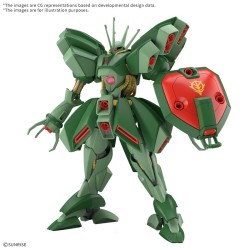
RG – Real Grade
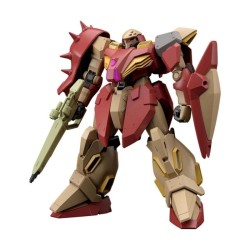
Real Grade (RG) models share the standard 1/144 scale with HG kits, but aim to deliver Master-Grade-level complexity and realism inside a compact footprint.
What makes RG kits unique is their ability to packed intricate mechanical detail, multi-shade armor panels, and layered articulation into a 13 cm kit.
RG models feature high piece counts, articulated inner skeletons (Advanced MS Joint frames), and intricate surface paneling to replicate real-world mechanical aesthetics.
As a result, even though RG and HG kits share the same physical scale, an RG kit should not be viewed simply as an overpriced HG. They represent entirely different engineering philosophies.
MG – Master Grade
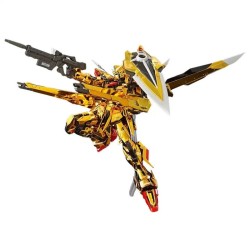
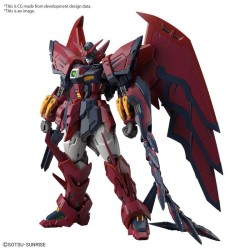
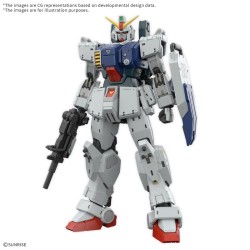
Master Grade (MG) kits are molded in 1/100 scale, making them visibly larger than 1/144 scale HG and RG models.
The larger scale allows Bandai to implement complete inner skeletons, functional cockpits with pilot figures, layered armor plating, and intricate mechanical gimmicks.
MG kits are ideal for modelers who enjoy longer, more technical builds and want a striking centerpiece for their display shelves.
Within this line, Bandai also offers flagship variants like MGEX (Master Grade Extreme), which push specific engineering elements—such as LED lighting systems or metallic frame finishes—to absolute limits.
A prime example is the MGEX 1/100 MIGHTY STRIKE FREEDOM GUNDAM, combining Master Grade proportions with extreme structural detail and premium engineering features.
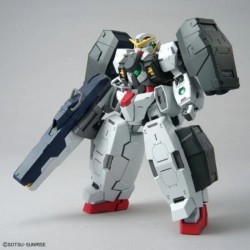
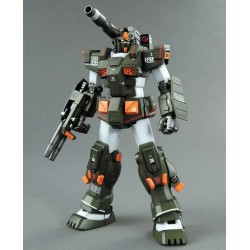
PG – Perfect Grade
Perfect Grade (PG) models represent the absolute pinnacle of traditional Gunpla engineering. Produced in 1/60 scale, these kits stand around 30 cm tall.
This massive scale allows for fully working joint linkages, opening maintenance hatches, full metal/plastic hybrid internal skeletons, and integrated LED light kits.
PG kits are engineered for experienced hobbyists looking for a flagship, multi-week building project. Due to their high part counts and complexity, they are rarely recommended for absolute beginners.
The true appeal of a PG lies not just in the imposing finished model, but in appreciating the incredible internal mechanics as you assemble it step by step.
SD – Super Deformed
SD (Super Deformed) kits depart from conventional HG, RG, or MG styling. Rather than adhering to realistic proportions, the SD format is defined by chibi, exaggerated proportions.
Mobile Suits feature oversized heads, prominent eyes, and compact torsos and limbs, creating a fun, stylized look.
However, SD kits should not be automatically dismissed as simplistic. The SD lineup encompasses several distinct sub-lines offering varied levels of articulation, color separation, and detail.
These sub-lines include SD Gundam EX-Standard, SD Gundam Cross Silhouette (SDCS), and other generations of SD mecha.
One noteworthy evolution is MGSD (Master Grade Super Deformed), which combines chibi SD proportions with complex Master Grade inner frames, advanced articulation, and multi-layered armor gimmicks. The result is a kit with cute proportions that packs high-end internal detail.
Therefore, SD should not automatically be equated with "easy," "basic," or "low quality." It is primarily a design aesthetic rather than a measure of build difficulty.
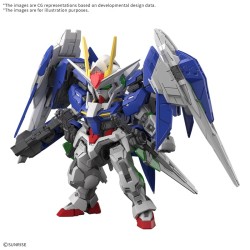
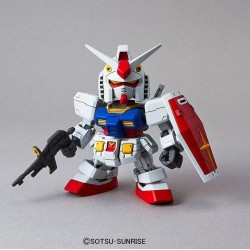
Mega Size: When Size Matters
Mega Size Model kits scale up the Gunpla concept to an impressive 1/48 scale, resulting in giant 37 cm figures with unmatched shelf presence.
Despite their massive size, Mega Size kits are engineered with simplified, gate-cut runners that make assembly surprisingly straightforward and stress-free.
They are proof that size, grade, and build difficulty are distinct factors—offering an impressive, huge display model without the microscopic part complexity of a PG kit.
Entry Grade: The Perfect Starting Line
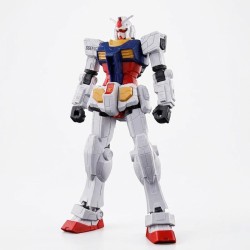
Entry Grade (EG) kits are designed specifically to make Gunpla accessible to absolute beginners and younger fans.
Featuring runner gates designed so parts can be snapped off by hand without tools, EG kits offer a low-friction build with great color separation and crisp proportions.
They serve as an ideal gateway for anyone wanting to try scale modeling without investing in specialized tools right away.
Experienced builders also enjoy EG kits as fast afternoon projects or as cheap canvases for painting practice and custom modifications.
Which Gunpla Should You Choose First?
There is no single "best" Gunpla for everyone. Your ideal starting kit depends on your experience, budget, display space, and—above all—which Mobile Suit design you like best.
As a general starting point:
- For your very first build: An Entry Grade or modern HG kit offers the smoothest entry point.
- For maximum detail in a compact size: An RG kit delivers impressive technical detail in 1/144 scale.
- For a larger model with inner skeletons: An MG kit is a fantastic match.
- For a flagship, large-scale challenge: Consider stepping up to a PG kit.
- For fun, stylized mecha looks: SD kits provide a charming aesthetic shift.
- For an impressive, huge display figure: Mega Size models deliver unmatched scale.
Ultimately, do not select a kit based on grade alone. Choosing a Mobile Suit design you genuinely love is the most important factor. Building a suit you are passionate about makes for a far more rewarding experience than picking a kit solely for its grade badge.
Do You Need Tools to Build Gunpla?
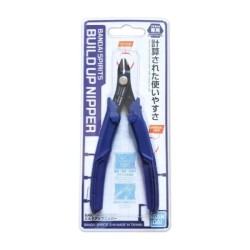
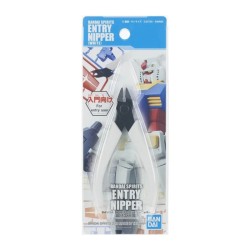
One of Gunpla's greatest strengths is that basic snap-fit construction requires no glue or specialized workshop tools. However, investing in a few entry-level modeling tools will dramatically improve your build experience and finish quality.
A decent pair of single-blade plastic nippers allows you to cut parts cleanly from the runners. From there, hobby knives, glass files, or sanding sponges help clean off leftover runner nubs seamlessly.
You can also use fine-tip markers or liquid panel line accent washes to fill armor seams, bringing out hidden surface detail, along with waterslide decals for added military flair.
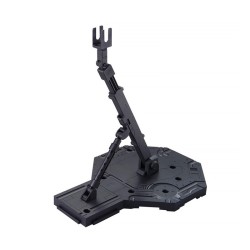
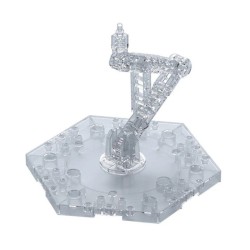
Once assembly is complete, Gunpla display bases are another extremely useful accessory for displaying and presenting your model kits. They allow you to pose your model in dynamic action stances and take full advantage of its articulation and movement, especially on Gunpla designed for mid-air aerial poses.
You can easily start with minimal tools and expand your toolkit as you gain experience and look to refine your technique.
Do You Have to Paint Gunpla?
No, you do not need to paint Gunpla to get great results. Modern kits are molded in multi-colored plastic runners that accurately match the Mobile Suit's screen colors right out of the box.
That said, custom painting unlocks endless creative freedom. You can alter color schemes, apply weathering and battle damage effects, or airbrush factory-clean finishes.
This scalability makes Gunpla uniquely appealing: for some builders, straightforward snap-fitting for a display shelf is complete perfection; for others, assembly is just the first step of a major painting project.
Gunpla: More Than Just Model Kits
Gunpla bridges two vibrant worlds: the rich sci-fi lore of Gundam and the hands-on creativity of scale modeling.
With diverse grades catering to every preference—from tool-free Entry Grades and versatile High Grades to detailed Master Grades, flagship Perfect Grades, and charming SD kits—there is a project for every builder.
Best of all, there is no single "correct" way to build Gunpla. You can enjoy a quick weekend snap-fit, take time polishing every nub mark, apply panel lines and decals, or fully airbrush a custom creation.
Ready to start your journey? Explore our full catalog of Gunpla model kits and modeling supplies at El Taller del Modelista to find the perfect Mobile Suit for your workspace!
Frequently Asked Questions About Gunpla
What does Gunpla mean?
Gunpla is a portmanteau of Gundam and Plastic Model, used to describe official plastic model kits based on the Gundam franchise.
What is the difference between Gundam and Gunpla?
Gundam is the overarching anime and sci-fi franchise, while Gunpla refers specifically to the scale plastic model kits derived from its mecha designs.
What does HG mean in Gunpla?
HG stands for High Grade. It is the most popular and expansive Gunpla line, mostly produced in 1/144 scale.
What is the difference between HG and RG?
While both generally share the 1/144 scale, RG (Real Grade) kits feature advanced inner skeletons, finer panel details, and higher part counts compared to HG kits.
What does MG stand for?
MG stands for Master Grade. These 1/100 scale kits feature full internal skeletal frames, functional gimmicks, and greater size than HG and RG models.
What scale is a Perfect Grade (PG) Gunpla?
Perfect Grade kits are built in 1/60 scale, standing around 30 cm tall with extensive structural detail and intricate mechanics.
What does SD mean in Gunpla?
SD stands for Super Deformed. It is defined by cute, chibi proportions featuring oversized heads and compact bodies rather than a realistic scale ratio.
Are SD Gunpla kits easy to build?
Not always. While standard SD kits are beginner-friendly, advanced sub-lines like MGSD incorporate Master-Grade-level inner frames and intricate parts alongside SD proportions.
Do I need glue to assemble Gunpla?
No. Modern Gunpla kits use snap-fit engineering and do not require glue for standard assembly. Glue is only used for advanced custom modifications or repairs.
Do I need to paint my Gunpla?
No. Kits come molded in pre-colored plastic matching the suit's canonical colors. Painting is optional for builders looking to customize or add realism.
What is the best Gunpla kit for a beginner?
Entry Grade (EG) and High Grade (HG) kits are ideal starting points due to their simple construction, affordable price, and forgiving assembly.
Share this content