 search



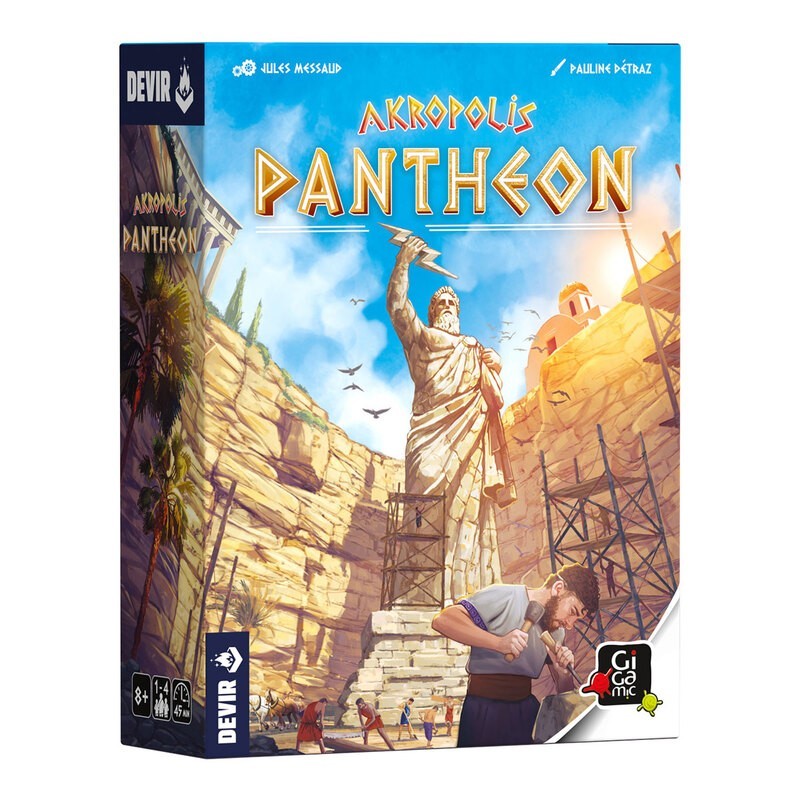
Akropolis: Pantheon is a cooperative expansion for Akropolis that turns the competitive city-building experience of the base game into a shared challenge. Former rival architects must join forces to construct a magnificent Capital and work together to achieve the highest possible group score.
Data sheet
Akropolis: Pantheon is a cooperative expansion for Akropolis that turns the competitive city-building experience of the base game into a shared challenge. Former rival architects must join forces to construct a magnificent Capital and work together to achieve the highest possible group score.
To secure victory, players need to carefully coordinate decisions, manage their collective stone reserves, and fulfill various Architectural Challenges required to erect divine altars dedicated to the city's guardian gods.
Akropolis: Pantheon requires the base game Akropolis to play.
At the start of each game, players collectively choose one of three scenarios: Corinth, Sparta, or Athens. Each scenario sets a unique difficulty level, allowing your group to steadily scale up the strategic challenge.
Each architect receives a starting tile and three City tiles held in hand. Unlike the base game, Pantheon dispenses with a public drafting river; players must coordinate using only the hidden tiles within their hands.
On your turn, you can play a tile to develop your personal city and complete an Architectural Challenge, or contribute directly to constructing the shared Capital. At the end of your turn, you draw back up to a three-tile hand limit.
The 20 Architectural Challenges are a core feature of this expansion. Each challenge requires architects to accomplish a specific structural pattern within their personal city layouts.
Completing a challenge awards the group an associated Divine Altar. These altars can subsequently be built into the shared Capital, serving as essential components for earning end-game victory points.
Challenges force players to plan collaboratively, deciding which construction projects best advance both individual city layouts and the growth of the shared Capital.
The 20 Divine Altars honor the patron deities of the Capital. Depending on the color of a district space, players can place the corresponding altar for Hestia, Hermes, Ares, Zeus, or Demeter.
In Pantheon, Plazas function differently than in the base game. For a Capital Plaza to trigger and score points at the end of the game, it must feature its matching Divine Altar.
This creates a direct link between Architectural Challenges and Capital development: completing challenges not only unlocks bonuses, but activates the vital scoring spaces across the shared city.
The major innovation in Akropolis: Pantheon is its fully cooperative drive toward a single goal. Every tile placement contributes to the shared Capital, meaning every individual choice impacts the group's overall result.
Architects must evaluate when to use a tile to fulfill a challenge and when to place it straight into the Capital. Balancing stone reserves and spatial placement ensures high-value spots receive their necessary altars.
Pantheon comes packed with three scenarios: Corinth, Sparta, and Athens. Each introduces unique scoring thresholds and victory requirements.
This scenario-based progression lets groups start with a accessible introduction before tackling higher-level tactical requirements. Victory is not merely finishing the game, but surpassing the strict point threshold of your chosen scenario.
This expansion dramatically reshapes how you approach Akropolis. Instead of striving to outbuild rival cities, you and your fellow players focus on discovering the most efficient way to raise a grand Capital together.
Table communication, forward planning, and capitalizing on shared opportunities become paramount. Each player must evaluate how their tile placements can best support the team's overarching goals.
Akropolis: Pantheon offers a fresh way to enjoy the 3D tile-placement system of Akropolis. Transitioning to cooperative gameplay completely shifts your priorities: optimizing your personal layout is no longer enough unless it directly serves the Capital's final score.
Architectural Challenges provide clear objectives that guide personal city expansion, while Divine Altars bridge those achievements directly to the Capital's scoring engine. The result is a satisfying blend of individual puzzle-solving and shared tabletop strategy.
Akropolis: Pantheon is ideal for fans of Akropolis looking to experience a completely different gameplay style. Its cooperative structure allows players to discuss turns collaboratively and tackle scenario challenges as a team.
It is also a great fit for players who love cooperative board games, tile placement, and city-building games that offer fast play times alongside constant tactical choices.
Designed for 1 to 4 players aged 8 and up, with fast matches taking approximately 25 minutes.
If you enjoy tile-placement, city-building, and spatial strategy games, consider exploring these complementary titles:
Akropolis: Pantheon turns the city-building mechanics of Akropolis into a cooperative strategy game where all players pool their talents to construct a grand ancient Capital.
With its Architectural Challenges, Divine Altars, and three escalating scenario difficulties, it introduces fresh strategic objectives that require clear teamwork from the first tile placement to the last.
If you are looking to buy Akropolis: Pantheon, keep in mind that this is an expansion and requires the base game Akropolis to play. It is an ideal pick for players who want to add a cooperative mode to their collection and conquer tactical scenarios together.
Be the first to ask a question about this product!



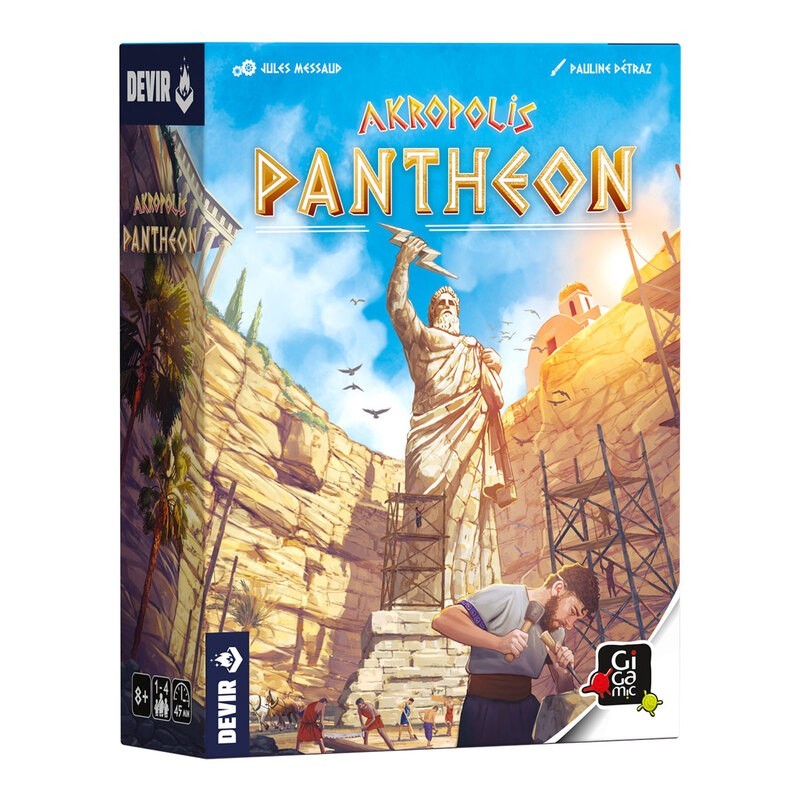
Akropolis: Pantheon is a cooperative expansion for Akropolis that turns the competitive city-building experience of the base game into a shared challenge. Former rival architects must join forces to construct a magnificent Capital and work together to achieve the highest possible group score.